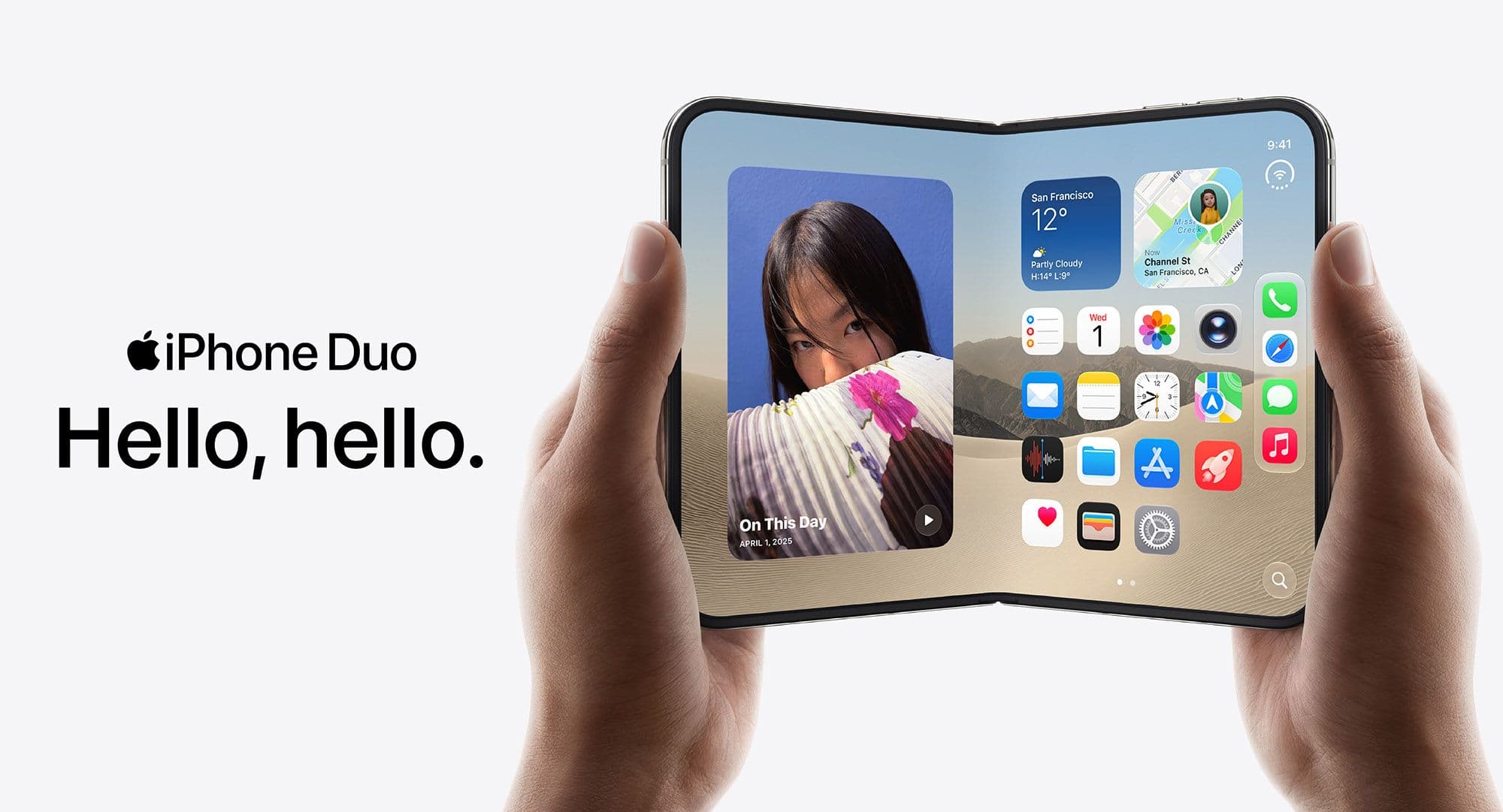
The wait has been long, but the revolution is underway. Announced during the “Surprise and Shine” keynote on 9 September 2026, the iPhone Duo marks Apple’s long-awaited entry into the foldable smartphone market. Apple has taken the time to refine this new generation of iPhone, drawing on recent technological advances to deliver a more polished model that meets users’ expectations.
The event was historic for another reason: it marked John Ternus’s first public appearance as Apple’s new CEO, succeeding Tim Cook as of 1 September. And to mark the occasion, the famous “One more thing” made its return. A redesigned design, a powerful A20 Pro chip and a tailor-made version of iOS 27.
A “passport” design that redefines the foldable experience
While competitors have often opted for tall, narrow formats when closed (more like a remote control), Apple has taken a radically different approach. The iPhone Duo adopts proportions reminiscent of a passport.
A titanium hinge built to withstand the elements
The mechanical engineering behind the iPhone Duo is impressive. At just 5.2 mm thick when unfolded, it is the thinnest iPhone ever designed by the Californian brand (when opened). Its frame is made of polished Grade 5 titanium, while the central hinge, made up of more than one hundred micro-components, is protected by 3D-printed, micro-blasted titanium.
When it comes to durability, Apple goes all out with an IP68 rating. The iPhone Duo can withstand immersion in up to 6 metres of water for 30 minutes. This is a remarkable technical achievement for a device featuring such complex articulated mechanics. The front surfaces are protected by the next-generation Ceramic Shield, which is three times more scratch-resistant.
Two exceptional OLED displays and an (almost) invisible crease
The real battleground for foldable smartphones is the display.
- The external display: A 5.4-inch OLED panel, wide enough to be comfortably used with one hand, just like a conventional smartphone.
- The internal display: Once unfolded, the iPhone Duo reveals a stunning 7.6-inch OLED display.
Apple’s major achievement? The near-total disappearance of the central crease. Thanks to a ten-layer assembly, a titanium support layer and a nano-textured anti-reflective surface treatment, the crease is almost imperceptible from the front and to the touch. To top it all off, both 120 Hz (ProMotion) displays offer brightness of up to 3,000 nits and are compatible with Apple Pencil (USB-C).
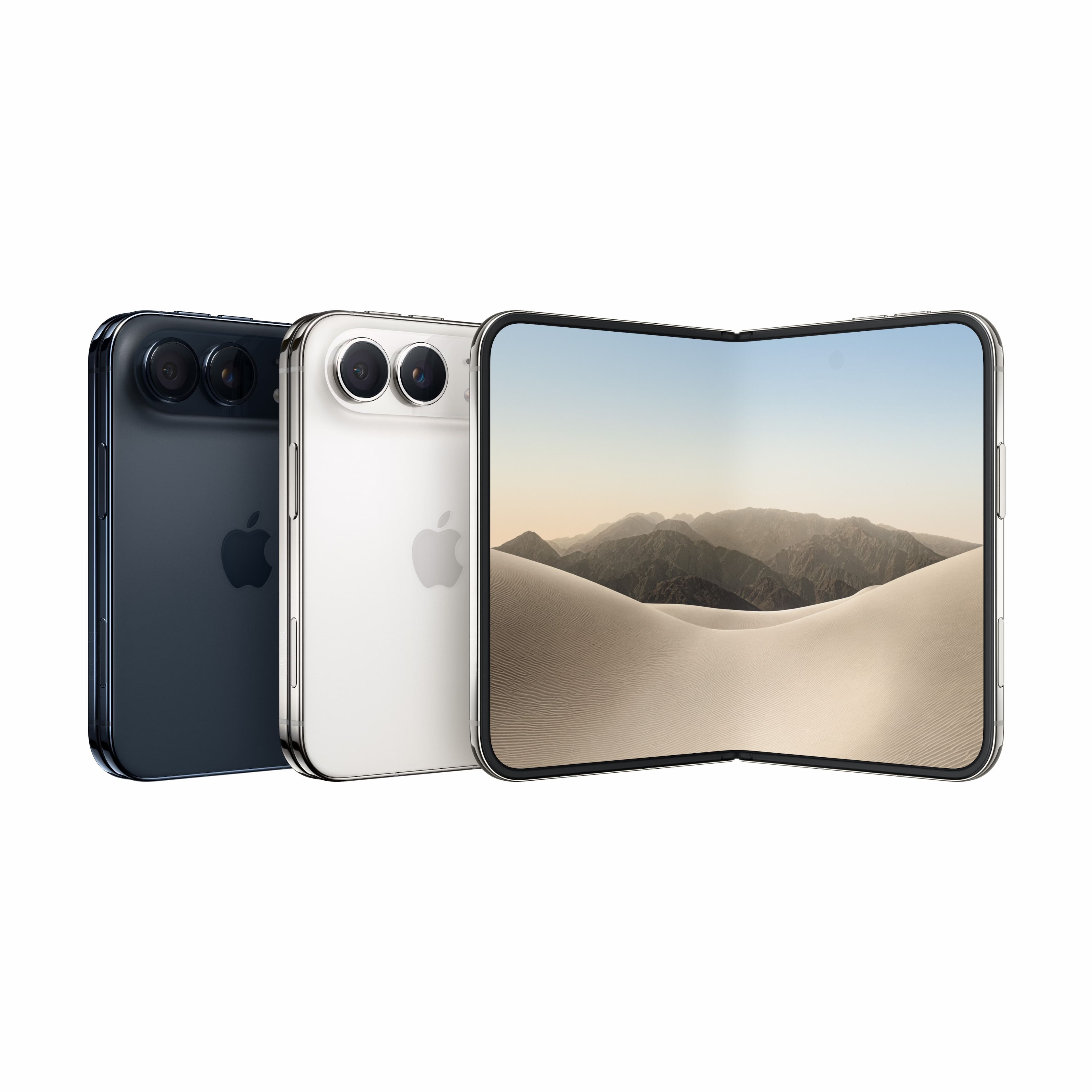
Power and Battery Life: The Engine Behind the iPhone Duo
To power such a device without compromising its slim design, Apple had to innovate at the very heart of its components.
A20 Pro Chip
The iPhone Duo introduces the A20 Pro chip, manufactured using an advanced 2-nanometre process. This powerhouse features 6 CPU cores and 7 GPU cores, but stands out above all for its two 16-core Neural Engines, designed to handle on-device AI tasks with ease.
To prevent overheating in a chassis just 5.2 mm thick, a cooling system has been integrated directly into the titanium frame. The physical SIM card also disappears completely, replaced by an eSIM-only setup.
Photography and Interface: An Enhanced User Experience
While the iPhone Duo does away with the optical telephoto lens found on Pro models in order to maintain its slim profile, it makes up for it with impressive software and user-focused innovations.
Cameras Designed for the Foldable Format
The 48-megapixel main “Fusion” camera supports Dolby Vision 4K video recording at 120 frames per second. But it’s the foldable design that really changes the game:
- Duo Preview: Your subject can see themselves on the external display while you take their photo.
- Smart Take: Artificial intelligence (Apple Intelligence) automatically detects when everyone is ready and holding still, then takes the photo.
- Under-display camera: The dedicated camera for video calls is hidden beneath the display pixels, providing a full-screen viewing experience with no notch.
To keep the device as thin as possible, Face ID is also replaced by a biometric Touch ID sensor integrated directly into the side button.
iOS 27: The Art of Multitasking
The operating system has been completely redesigned for this format. iOS 27 finally introduces Split View on iPhone, allowing two apps to be displayed side by side.
When you place the device half-folded on a table (stand mode), the screen splits in two: the video appears at the top, with the controls at the bottom. A dynamic “StandBy” mode also lets you use the external display as a bedside clock or digital photo frame without having to plug in the device.
Availability in Luxembourg
The iPhone Duo is clearly positioned as an ultra-premium product, targeting pioneering tech enthusiasts and mobile professionals.
Pre-orders will open on Friday, 16 October 2026 at 2:00 p.m. local time.
FAQ: Frequently Asked Questions About the iPhone Duo
1. Is Apple’s iPhone Duo waterproof?
Yes, the iPhone Duo is IP68 certified according to the IEC 60529 standard. It can withstand continuous immersion in water at a depth of up to 6 metres for 30 minutes, a remarkable achievement for a smartphone with a mechanical hinge.
2. Does the iPhone Duo feature Face ID facial recognition?
No. Due to the extreme thinness of the unfolded display (5.2 mm), Apple was unable to integrate the TrueDepth sensors. Security is provided by a Touch ID fingerprint sensor located on the side lock button.
3. Can you use a stylus with the iPhone Duo?
Absolutely. Both the 5.4-inch external display and the 7.6-inch foldable internal display are compatible with Apple Pencil (USB-C), allowing you to take handwritten notes and draw with precision.
4. When will the iPhone Duo be available in Luxembourg?
Pre-orders for the iPhone Duo will begin on Friday, 16 October 2026 at 2:00 p.m. (Paris time).
5. Is the crease on the iPhone Duo’s internal display visible?
Apple has managed to make the central crease almost invisible. Thanks to a titanium reinforcement plate beneath the display and a nano-textured surface treatment that reduces reflections, the crease is barely visible from the front and is very subtle to the touch.